Due to the development of digital technology, the retail industry has changed. When you analyse how consumers buy products, most of the journey of shopping has been digitizsed. Zara is a Spanish clothes and accessories fashion retailer which is the flagship brand of the Inditex Group, which is devoted to providing customers with a more convenient and enjoyable experience (Hansen, 2012). Zara has successfully built a digital business model to predict customer behavior and respond quickly, contributing to its leading position in the competitive fast fashion industry rather than being left behind by the technology. Nowadays, Zara is the world’s largest retailer and Zara eCommerce is one of the most successful eShops in the world. The following content will discuss and evaluate how the digital business model of Zara has contributed to its success.
As Uberoi (2017) claimed, the value of fast fashion brands is to bring the latest designs and trends to the market as soon as possible. Zara is targeting young and price-conscious consumers who are especially highly sensitive to the latest fashion trends (Harbott, 2011). Most traditional fashion industry runs on a bi-annual or seasonal basis, which leading to long production lead time, high stock inventory and inefficiency (Uberoi, 2017). Contrarily, one reason contributing to the success of Zara is their integrated supply chain. Zara’s strategies of reshaping supply chain paradigms and customer-to-brand relationships has made them a bold and courageous brand, setting a new standard for end-to-end value in a digital landscape.
Zara has currently operated in 96 countries and expanded 2200 stores around the world (Tradegecko.com, 2018). With such a wide range of business, it is important for Zara to be familiar with its customers and their preferences in order to ensure consistent customer interaction with fashion products and manage supply and demand in the global offline store and online channel ecosystem. Therefore, Zara makes use of digital technology to successfully build a flexible and efficient supply chain.
The data helps check the stocking by tagging every piece of clothing with a radiofrequency identification (RFID) microchip in order to track real-time inventory until being purchased by customers (Uberoi, 2017). Therefore, the data about inventory and the speed of a particular stock-keeping unit (SKU) moving from the shelf to the point-of-sale (POS) are constantly uploaded to the data processing center on a real-time basis from around the world (Uberoi, 2017). Besides, RFID helps to determine which items need to replenish which has enabled Zara’s inventory and stock take 80% faster than before (Uberoi, 2017). This also helps every store receive tailored inventory replenishment according to SKU inventory data on a real-time basis. In addition, Zara applies personal digital assistants, to capture real-time consumer data, such as transactions and preferences of value (O’Marah, 2016). The designers would look at the sales data from all around the world to determine the designs and make changes accordingly (Uberoi, 2017), as well as receive feedback from sales at least twice a day through the network inside Zara (Zhang, 2014). The headquarters will make decisions and send them to the production line to change clothing styles, catering to customers’ taste and preferences (Zhang, 2014). This means Zara can make improvements in time, significantly decreasing the amount of stock inventory, reducing waste and providing customers what they really want.

Zara’s employees receive real-time data from around the world in the Data Processing Center – Retrieved from https://digital.hbs.edu/platform-digit/submission/zara-achieving-the-fast-in-fast-fashion-through-analytics/
However, although big data is useful to increase efficiency and deliver value to customers, the most important factor is whether managers and manufactures have abilities to make changes as soon as possible by following up customers’ feedbacks and demands. For example, H&M is looking forward to leveraging big data and analytics to increase profit, but they failed in quickly responding to the changing demands and trends (Nigania, 2018).
In the long term, Zara is increasingly focusing on digitalisation of consumer shopping experience. Zara has used social media platforms as a means for advertisements and interactions with customers, giving social media users the opportunity to review the latest launched products and learn about updated news. Zara has also adopted AI-powered chatbots to provide real-time assistance to offer more personalised service (Nigania, 2018). Besides, another application of disruptive technology is improving the click collection process. There are more customers preferring to order online and pick up in stores, Zara has used background robots to help customers get their orders in a more efficient way and this way can reduce human error (Morgan, 2019). This is also a key factor to reduce the backlog in stores.
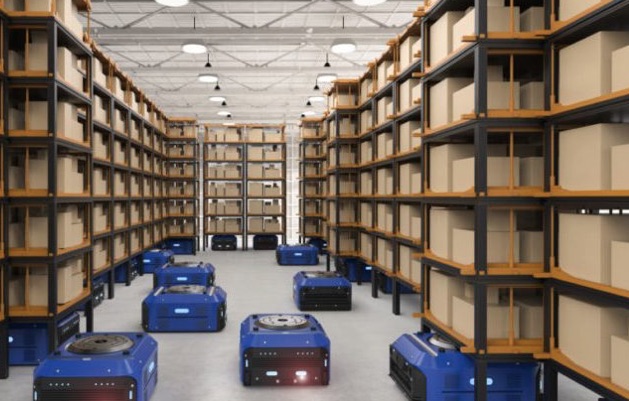
Zara uses robots to fulfill customers’ orders – Retrieved from https://blog.contactpigeon.com/zara-ecommerce/
Although e-commerce platform has been popularised, Zara did not forget traditional shoppers. Zara’s latest technology enables customers to see virtual models wearing selected piece of clothing in Zara, walking and even talking through cameras on the smartphone and purchasing clothing on the model through the app (Kollinger, 2018). This is an interesting and surprising idea to provide an interactive experience to combine augmented reality elements into the real-world environment.
There are still other aspects of application of digital technology by Zara, including self-checkout and the product recommendation system based on embedded information screens (Wonner, 2018). There is no doubt that Zara’s digital business model helps establish an efficient supply chain, build a more connected relationship with customers and bring competitive advantage to the organisation. However, the increasing use of digital technologies would lead to a high demand of high-tech talents so that the labour cost may increase. Besides, if managers cannot respond and make quick and right decisions to change, digitisation is no difference. Therefore, it is significant for businesses to collaborate with digital tools, keeping up with the fast change of trends, predicting and analysing customers’ behaviours and continuously innovating to create value for organisations.
Sources:
- Harbott, A. (2011). Analysing Zara’s business model. Retrieved from https://harbott.com/analysing-zaras-business-model-6ee755699a70
- Hansen, S. (2012). How Zara Grew Into the World’s Largest Fashion Retailer. Retrieved from https://www.nytimes.com/2012/11/11/magazine/how-zara-grew-into-the-worlds-largest-fashion-retailer.html
- Kollinger, S. (2018). Zara Is Changing How We Shop Through Augmented Reality. Retrieved from https://www.refinery29.com/en-us/2018/04/196382/zara-augmented-reality-app
- Morgan, B. (2019). The 20 Best Examples Of Using Artificial Intelligence For Retail Experiences. Retrieved from https://www.forbes.com/sites/blakemorgan/2019/03/04/the-20-best-examples-of-using-artificial-intelligence-for-retail-experiences/#109743f14466
- Nigania, J. (2018). ZARA: Leveraging AI, Big Data and Analytics. Retrieved from https://www.houseofbots.com/news-detail/3173-1-zara:-leveraging-ai,-big-data-and-analytics
- Nathan, A. (2017). Zara & Big Data: A 5-Minute Case Study. Retrieved from https://medium.com/@adamnathan/zara-big-data-a-5-minute-case-study-72dd9cebcbc6
- Tradegecko.com. (2018). Zara supply chain analysis – the secret behind Zara’s retail success. Retrieved from https://www.tradegecko.com/blog/zara-supply-chain-its-secret-to-retail-success
- Uberoi, R. (2017). ZARA: Achieving the “Fast” in Fast Fashion through Analytics. Retrieved from https://digital.hbs.edu/platform-digit/submission/zara-achieving-the-fast-in-fast-fashion-through-analytics/
- Wonner, A. (2018). Zara and its digital revolution. Retrieved from https://www.linkedin.com/pulse/zara-its-digital-revolution-anne-wonner
- Zhang, J.R. (2014). Zara—a successful big data application. Retrieved from https://medium.com/@jiarongzhang/zara-a-successful-big-data-application-9ada5be0851d
 Siying Lu' blog
This is an interesting article! There is no doubt that capturing the latest fashion trends and responding to them in a timely manner is very important for fashion companies. In today’s digital age, advances in digital technologies (such as artificial intelligence, machine learning, and big data) can help fashion build a better business model. As Zara mentioned in this article, superior digital commerce is a very important factor in its success in the fashion industry. It uses digital technology to analyze big data to develop a more efficient production and sales plan.
赞Liked by 2 people
Hello Siying,
You have chosen a topic that I also find very interesting. Indeed, I very much agree with the impact of digitalization on the fast fashion industry. However, through your elaboration, I find that Zara has indeed become a leader in this industry. However, I am a little bit puzzled because the application of big data is not just a trend, but a common phenomenon. Therefore, how does Zara maintain an advantage in these competitions? In my opinion, it is not significantly different from H & M, Topshop, Mango.
Also, through some news, I learned that due to Chinese online sales such as Taobao, Jingdong and other websites, they provide more cost-effective clothing, and even the Chinese local fast-fashion brand UR’s sales inventory is much better than Zara. Despite the success of digitalization of Zara, a large number of fast fashion stores in China closed in 2019. This article has a more detailed report: https://www.globaltimes.cn/content/1149687.shtml.
赞Liked by 1 person
I can’t agree with you more. Zara has achieved remarkable results with the help of big data. As you mentioned, zara uses big data to help them analyze the demands and trends of consumers, which enables zara to make rapid production and sales and seize market share.
But not only zara but also zara’s competitors like H&M and Topshop can do the same, can zara become more successful by improving the quality of their clothing and customer service (online and offline)? We see a lot of bad reviews from consumers https://uk.trustpilot.com/review/www.zara.com.
As one of the consumers of zara, I think they need to provide their quality and customer service instead of just analyzing consumers’ hobbies and market trends. Because having this quality of product and customer service is also a path to success. So use the big data to collect customers’ feedback also are important.
赞Liked by 1 person
I agree with your analysis. Zara has realized efficient service and production by using information big data analysis to understand customer needs in a timely manner and implement intelligent production arrangements. In addition to the RFID you mentioned, ZARA has launched a two-week AR experience in 137 stores around the world. All products displayed by AR effects can be purchased through ZARA online stores or physical stores. Among them, there are 24 AR experience stores in China. Consumers think that AR technology makes shopping more interesting, helps brands improve their feelings in consumers’ hearts, and makes people more willing to stay in the store. On the other hand, due to the pressure of rent, Zara closed some stores. How can digital operations be combined with physical stores, or should most stores be replaced by online stores? These are issues that Zara may need to consider in the future.
赞赞
In this article, the writer mentions how digital data and technology is used in Zara (the world-leading fashion company). Big data helps Zara to find out customer preference so Zara designers could design products that customers may like. AR and VR help to present how their product looks on models and customers with actually wearing the cloth which could save much time. Moreover, big data also help to increase the process spend of Zara launching new products. Although using the result of big data collection could guarantee the sale in a safe extent, but it might against the idea of fashion. Fashion represents a new and fresh element of a moment while big data provide a historical record. Thus, designers should try to balance the use of big data and adding new ideas to the latest products.
赞赞