Retrieved from https://www.asim.rankmeup.in/blog/scope-of-digital-marketing-for-students-job-seekers/
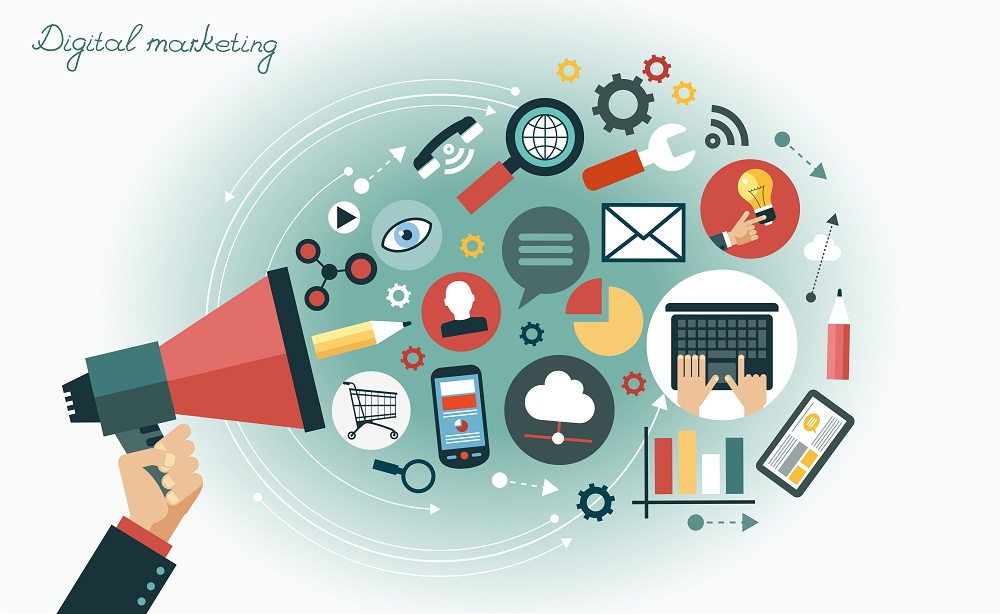
With the wide usage of the Internet and the increasing use of mobile devices, digital marketing has become a significant aspect of business and marketing, as it has opened up a new form of selling goods and services (Colquhoun, 2018). Digital marketing has many components, including social media, the Internet of Things (IoT), artificial intelligence (AI), augmented reality (AR) and virtual reality (VR).
Retrieved from https://landerapp.com/blog/content-vs-traditional-marketing/
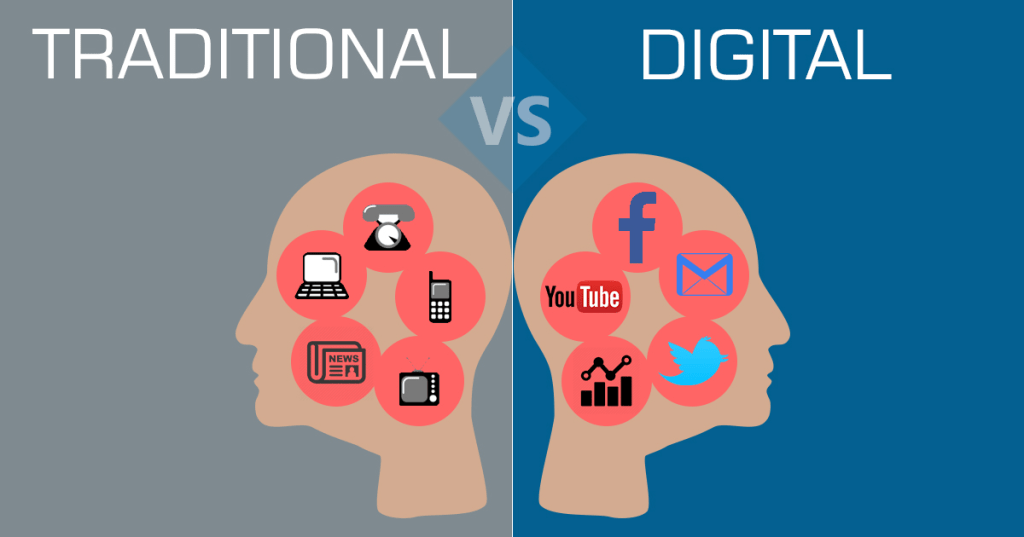
Traditional marketing advertisements often interrupted customers through irrelevant messages instead of delivering valuable information (Sharma, 2017) and therefore can be seen negatively. Contrarily, digital marketing channels such as social media can specifically target segments thus being more effective because digital marketing enables companies to use different platforms to reach different segments according to customers’ interests, education or income level, such as an online advertisement to younger people solely through Instagram. Besides, social media provides platforms to let customers interact with each other to exchange opinions which is more interesting, but it may lead to bad reputations if there are bad comments.
IoT also has a significant impact on modern marketing. Marketers can now use big data to calculate the demands and interests of customers based on data, such as web search history, purchase patterns or favourites, thus generating personalised data which drive the creation of specific information that is then delivered to customers (Saran, 2018). For example, I always watch influencers’ vlogs on YouTube, and then YouTube will provide some new recommendations which are closely related to what I have already watched or subscribed to. Therefore, in this personal example, it can be seen that big data helps to offer relevant and valuable information to customers, meaning the advertisements are aimed at target segments in a more effective and accurate method.
The marketing power of the Internet of Things – Retrieved from https://www.i-scoop.eu/how-the-internet-of-things-impacts-marketing/
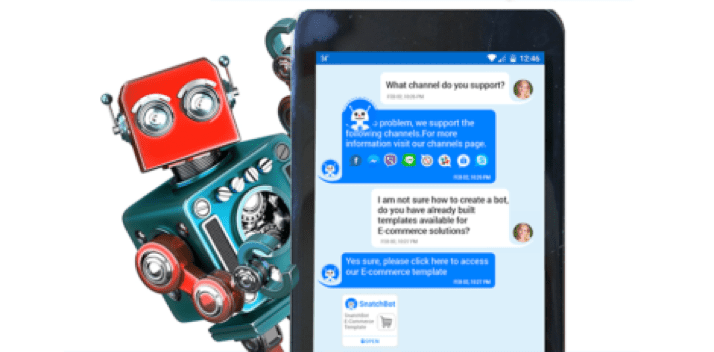
AI has also become an important tool in digital marketing, for example, adapting AI as Chatbots. Chatbots are automatic responders which means they can help reduce human error (Hall, 2019), produce quicker and relevant responses to customers at any time and can even provide customers with personalised services (Alford, 2019). Therefore, this example illustrates that AI can be useful in establishing good and close relationship with customers. Besides, AI is able to help marketers understand customers’ needs through the collection of data and information which can offer better insight into customer behaviour and preferences, in turn leading to better interactions and potentially higher sales (Alford, 2019). However, use of Chatbots often brings greater demand on the companies because people think companies can address problems as fast as they can and be online 24/7 (Agrawal, 2016).
AI chatbots – Retrieved from https://medium.com/@technaureusmarketing/trends-in-digital-marketing-2019-9980365892b4
Furthermore, AR and VR are also significant in the digital economy and both have changed marketing. Many people are increasingly eager for a unique and multisensory buying experience (Lazarus, 2017). This may be the primary reason why AR and VR are attractive. From my own personal view, the opportunity to see how one item of clothing, or beauty product looks on me before purchasing is attractive and interesting, as AR is able to combine digital elements with a live view via the camera on a smartphone. Some beauty brands, such as MAC or Estee Lauder, have, for example, created Chatbots to allow customers to try their makeup through AR, which has greatly contributed to sales due to higher engagement and interactions (Velasco, 2017).
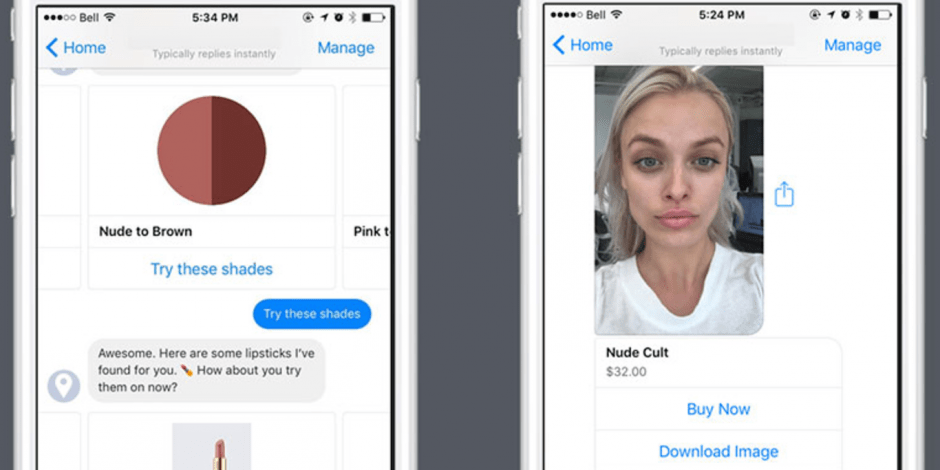
Estee Lauder created Chatbots using AR to enable customers to try on lipsticks virtually- Retrieved from https://www.thedrum.com/news/2017/07/16/est-e-lauder-and-modiface-create-chatbot-lets-customers-try-lipstick-virtually
VR is about a completely immersive experience which can provide customers with a unique experience to enable them to connect with products through new business models (Walker, 2018). For example, Alibaba created a new function called Buy+ to add a new shopping option for customers through its virtual store. People can go anywhere through the application of VR glasses which can make wearers experience and feel a totally different place to where they are. Therefore, VR has increased the loyalty of customers which has achieved more engagement and response than any other platforms (Bhatia, 2019).
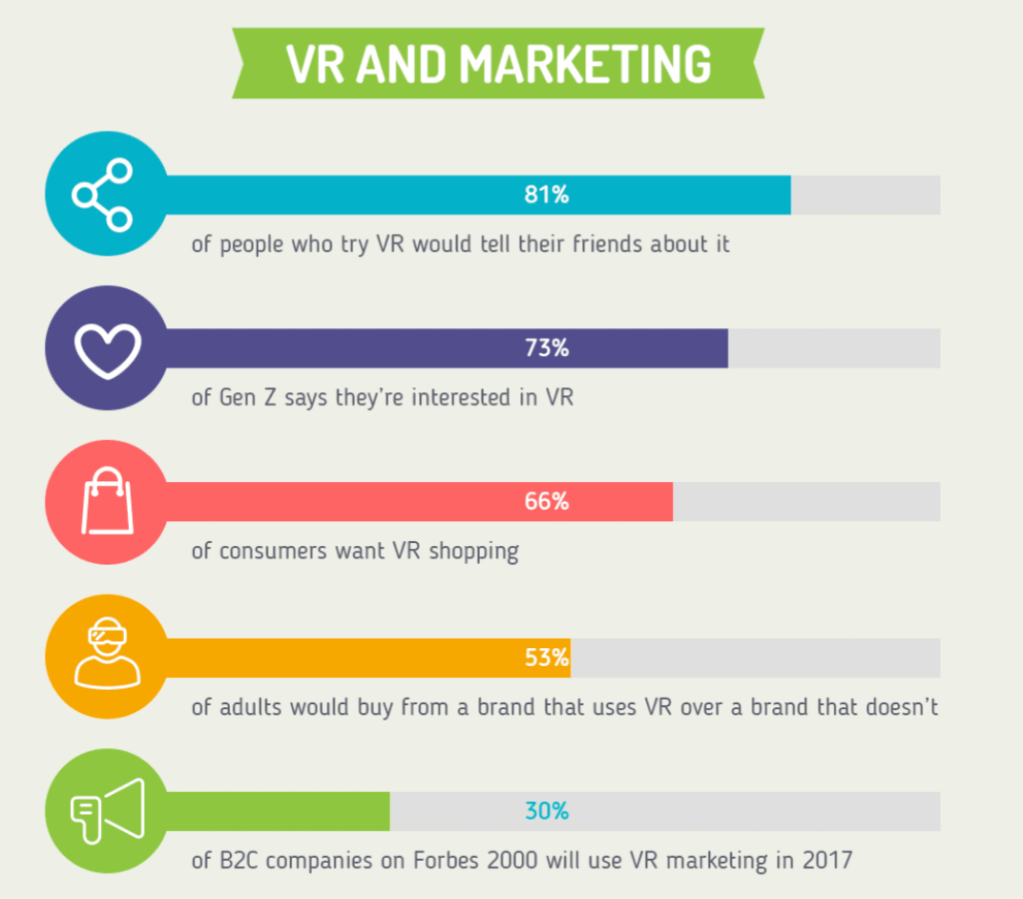
Why virtual reality matters to marketing – Retrieved from https://www.webfx.com/blog/marketing/why-virtual-reality-matters-to-marketing-infographic/
Retrieved from https://www.brightbridge.co/future-digital-marketing-look-like/
Digital transformation has obviously been popularised in marketing. The use of digital marketing has enabled organisations to constantly meet customers’ needs, as well as bringing benefits to organisations. It can be predicted that digital marketing using AI, AR or other relevant tools would be more popular and widespread in the future.
Personalisation is one of the major aspects of digital marketing in the future. Research has shown that at least 90% of online advertisers will start using personalisation, whilst there will be a significant increase of personalisation websites (Membrillo, 2019). This increase is because customers are more likely to feel respected and receive valuable messages which they appreciated, for example, data has demonstrated that personalised emails receive 29% higher open rates and 41% higher click-through rates than non-personalised emails (Membrillo, 2019).
Moreover, cooperating with social media influencers or bloggers will be more common as this method can establish a better connection with customers, because many people trust those who may be famous or they admire (Membrillo, 2019). Specifically, there are studies that indicate that 86% women consult social media before purchasing (Membrillo, 2019), thus demonstrating the importance of online marketing.
Furthermore, the digital economy requires marketers to be more transparent to customers in the future, especially to ensure customers know how the company handle customer’s data, and what kind of data will be used for the purposes of marketing (Membrillo, 2019). Moreover, it raised more key skills and training for the job position of marketing in the future, for example, innovative thinking, openness to lifelong learning, business insights from data analysis or staying up to date due to the fast pace of trends.
Sources:
- Alford, E. (2019). How to use chatbots as part of your marketing strategy. Retrieved from https://www.clickz.com/chatbots-part-of-your-marketing-strategy/224275/
- Agrawal, A. (2016). How The Digital Age Has Changed Marketing Channels Forever. Retrieved from https://www.forbes.com/sites/ajagrawal/2016/02/15/how-the-digital-age-has-changed-marketing-channels-forever/#25b7cfe2680a
- Bhatia, S. (2019). How VR Marketing is Impacting the Future. Retrieved from https://www.stanventures.com/blog/vr-marketing-impacting-future/
- Colquhoun, L. (2018). Success for salespeople in the digital economy. Retrieved from https://www.intheblack.com/articles/2018/07/01/sales-people-digital-economy
- Hall, J. (2019). How Artificial Intelligence Is Transforming Digital Marketing. Retrieved from https://www.forbes.com/sites/forbesagencycouncil/2019/08/21/how-artificial-intelligence-is-transforming-digital-marketing/#a36f35621e1b
- Lazarus, Z. (2017). The experience economy: key trends for 2017. Retrieved from https://www.campaignlive.co.uk/article/experience-economy-key-trends-2017/1431150
- Membrillo, A. (2019). 12 Digital Marketing Trends and Innovations for 2020. Retrieved from https://www.cardinaldigitalmarketing.com/blog/12-digital-marketing-trends-and-innovations-for-2020/
- Sharma, A. (2017). Digital Economy: From Traditional Marketing to Web Marketing. Retrieved from https://www.business2community.com/marketing/digital-economy-traditional-marketing-web-marketing-01913841
- Saran, J. (2018). How Can Big Data Contribute To Digital Marketing Success? Retrieved from https://www.forbes.com/sites/theyec/2018/11/08/how-can-big-data-contribute-to-digital-marketing-success/#4456529e1ca8
- Velasco, H. (2017). Estée Lauder and ModiFace create chatbot that lets customers try on lipstick virtually. Retrieved from https://www.thedrum.com/news/2017/07/16/est-e-lauder-and-modiface-create-chatbot-lets-customers-try-lipstick-virtually
- Walker, S. (2018). Virtual Reality Marketing: Is The Next Big Opportunity Already Here? Retrieved from https://www.digitaldoughnut.com/articles/2018/august/virtual-reality-marketing-is-it-already-here
 Siying Lu' blog
The points you made according changes in marketing in the digital economy are really interesting. I think from a business perspective, one of the biggest benefits for businesses from the advent of the digital economy are the new information resources that they can get through the Internet and the AI about their customers. It allows them to observe customer behaviour and purchasing process of its customer and adapt accordingly. Additionally, the development of social media and influencers, enables companies specifically address their respective customer target groups, which was not possible with traditional marketing. Here is an article from Forbes observing the new benefits for companies due to influencer marketing.
Mathew, J. (2018). Understanding Influencer Marketing And Why It Is So Effective. Retrieved Febuary 2020, from Forbes: https://www.forbes.com/sites/theyec/2018/07/30/understanding-influencer-marketing-and-why-it-is-so-effective/
赞赞
Dear Siying,
I think your blog topic follows the trend and the entry point is very interesting. Here are some of my small opinions and views.
First of all, I extremely agree with the role of big data in the era of the Internet of Things. When I shop online, I often find some pushes of the same type of products that I have searched for. However, this also has some disadvantages. Don’t you think that after such a long period of time, our acceptance of new things will decline? We have formed a fixed thinking model, watching the same video, buying the limited set of goods, and we live on big data to make our own In the circle.
In addition, you mentioned the power and impact of using social media influencers. You might also have some knowledge of the famous Chinese beauty industry KOL Li Jiaqi who started to become popular last year. He is the champion of online marketing in China. In the era of big data, the way of marketing through live broadcast, he used his affinity to affect more Chinese people seeking beauty. If you want to know more, you can refer to this video: https://www.youtube.com/watch?v=R009okpifPY
Jing Jing
赞赞
I like the idea that made in this article and I agree with the writer opinion. Digital economy plays an essential role in marketing and it relates to our life closely. Digital technology benefits both businesses and consumers. For corporations, it allows the marketing department to collect consumer preferences, therefore, help the companies to produce a better product. On the other hand, consumers could use the digital technology AI, VR to improve the shopping experience by understanding the product inside out. However, I think that we should also raise the awareness of digital technology might impact. Currently, digital technology is still in the developing stage. As if human could not entirely control these technologies which might bring several effects such as leak of personal information. Thus, I think while we focus on developing multiple uses of technology, we should also concern the impact of losing control to AI.
赞赞